I build software that lets you watch hidden systems work.
Going deep on AI infrastructure, and always exploring tech, food and new places.
About me
I’m Swarina, a software engineer at Amazon. I work on backend and distributed systems, and
lately on AI infrastructure. Outside work I build whatever I’m curious about, and I like taking
each thing all the way to something that works.
I say yes to new things first and work them out on the way, in tech, in food, in travel.
Growing up, travel was never on the table. Now it is, and I keep a diary of it.
What I'm looking for
Problems that are fuzzy at the start and clear by the end. Right now I’m drawn to AI infrastructure: the systems that keep models running reliably at scale, and the tooling that makes what they do easier to see. I like learning in the open, moving fast, and work that still leaves room to travel and say yes to the next new thing.
Experience
Software Engineer II, AmazonDec 2025 to present · Bengaluru, India
Leading an event-driven task-management platform that took 540+ stores from paper to digital, replacing more than half of 120+ in-store workflows. Exactly-once processing rides an at-least-once queue through idempotency keys and conditional writes, and the workflow schema is versioned so definitions evolve with zero downtime.
Software Engineer I, AmazonJan 2024 to Dec 2025 · Bengaluru, India
Built the backend services and real-time streaming pipeline behind store productivity, classifying floor activity into direct and indirect labour from capture through enrichment to reporting. Led a phased rollout across North America, Europe and Japan that cut task resolution time by 21.7% and lifted order accuracy and throughput.
Software Engineer, UKGJul 2023 to Dec 2023 · Noida, India
Designed Java and Spring Boot REST APIs for workforce-management features on UKG Dimensions, serving ADP on a shared, multi-client platform without regressing other clients. Backed each change with test suites that raised coverage and cut regression bugs.
Product Engineer (Internship), Crio.DoJan 2023 to Jun 2023 · Bengaluru, India
Worked with the Backend Development track's product owner to build hands-on projects, learning material and mock interviews, bringing a learn-by-doing approach to the curriculum.
Tech Scholar (Apprenticeship), PhonePeNov 2022 to Jan 2023 · Remote
A selective backend apprenticeship in data structures, algorithms and services built with Spring Boot and Java, culminating in a portfolio of deployed projects.
React Developer (Internship), SmartifyNov 2021 to Apr 2022 · Remote
Built an internal CRM in React, Material UI and Supabase, shipping 20+ screens to a shared design system and wiring Supabase APIs for real-time updates.
Projects
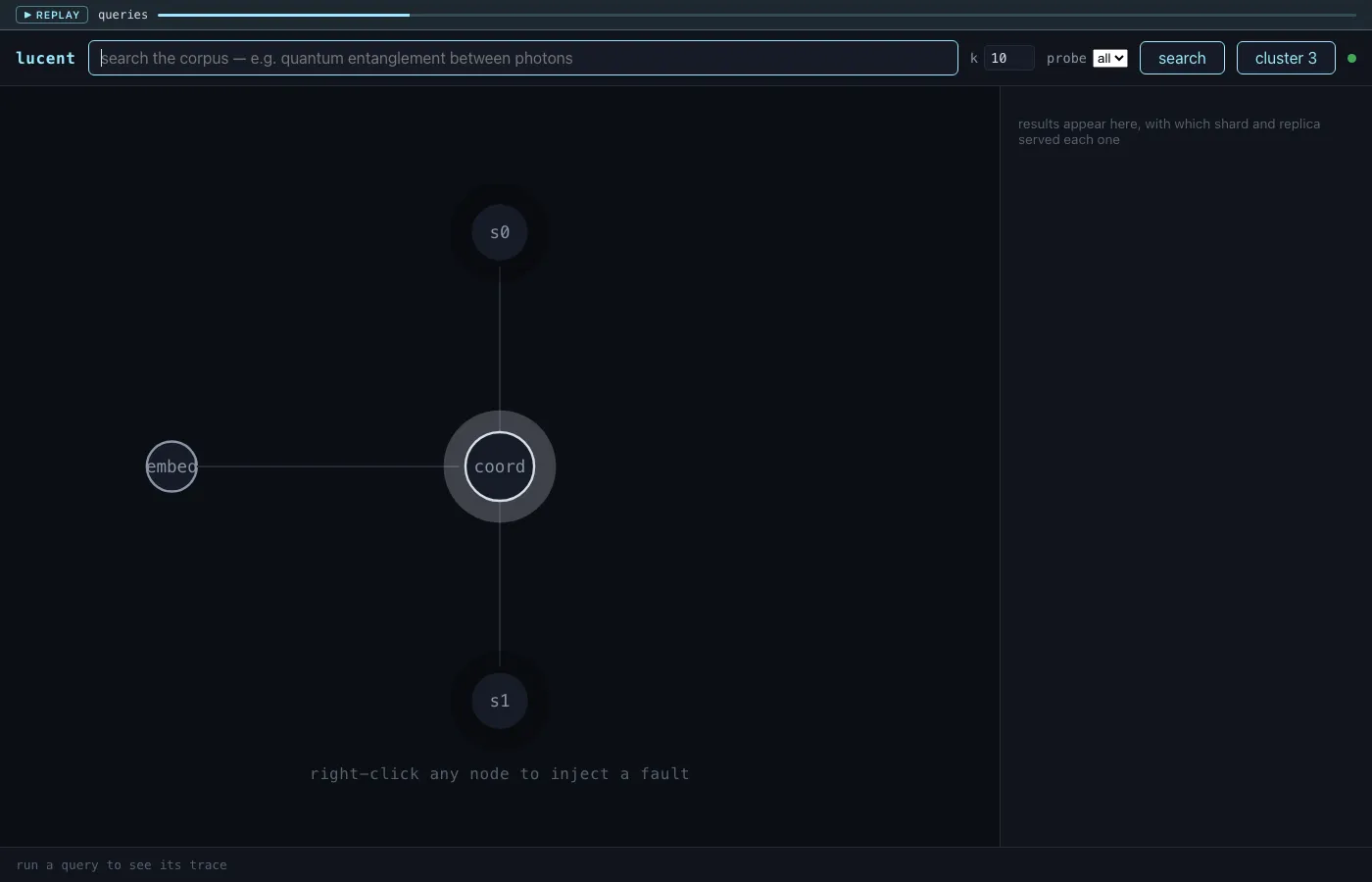
lucent
A distributed vector search engine you can watch think.
Self-hostable semantic search whose internals are the interface. Documents are embedded
locally with a CPU sentence-transformer, sharded across processes with a hand-rolled HNSW
index per shard, and replicated with automatic failover. A from-scratch mini-Raft owns the
shard map through consensus.
Every query’s journey renders live: embedding, shard routing, the approximate
nearest-neighbour traversal on each shard, the merge, and any failover along the way. The
hosted demo replays a real session entirely in the browser.
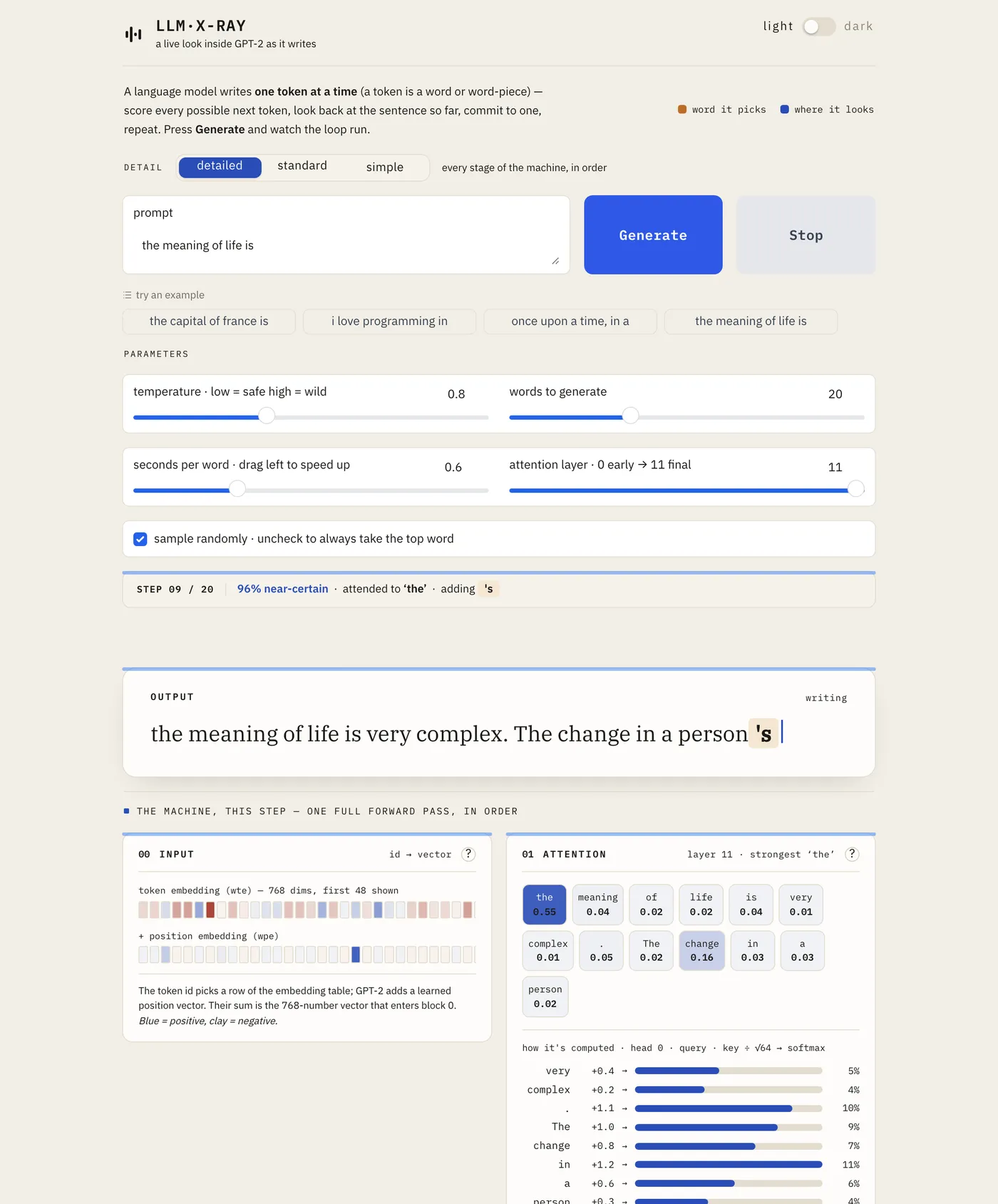
See how an LLM works end to end, live, on a real GPT-2.
Not a diagram of how language models work, but the real machine running. A real GPT-2
generates text one token at a time with every stage of the forward pass exposed:
tokenization, embeddings, attention, the feed-forward network, the prediction forming layer
by layer, and sampling. Every number on screen comes from the model itself.
It began as a fact-check of an article on how LLMs work and grew into a tool for seeing the
pipeline instead of reading about it.
Type a URL and watch your packet leave home, dive into a submarine cable on the ocean floor,
hop through internet exchange points and arrive on another continent, animated on a 3D globe
with cinematic camera work.
It uses real traceroute data from probes around the world, city-level geolocation, more than
400 real submarine cable routes, and a comparison against the speed of light.
Ask your own questions of every job posting, answered with calibrated probabilities.
Most job search tools pull a fixed set of fields from each posting, because running a
language model over every posting for every question would be too slow and too costly.
Quarry takes the other road. A daily pipeline answers a standard set of questions about
every posting with typed values and calibrated probabilities rather than generated text,
so “remote or hybrid, at least 70 percent” means something and a posting nothing has been
asked about is never shown as a no.
You can then ask your own question of the postings a search leaves, answered on demand and
bounded by a budget that reserves before it spends. Search runs entirely in the browser over
a static, content-addressed index, so a query lives in the URL, the back button works, and
nothing is logged.
A local-first checker for why your prompt cache is not paying off.
Every major provider discounts a repeated prompt prefix heavily, but only when the prefix is
byte for byte identical to the last one. When it is not, nothing warns you: a normal response
arrives at full price. Groundhog finds the reasons that happens, names each one, and says what
to do about it.
It runs entirely on your machine, with no account and no network calls on the check path.
Anthropic and OpenAI are covered today, plus a generic OpenAI compatible endpoint, and every
number it prints carries its confidence, so you always know what is measured and what is still
a guess.
A productivity layer that makes Claude Code and Codex sessions cheaper and sharper.
A thin layer of shared working defaults, a few skills and scripts, and a measurement loop for
Claude Code and Codex. It configures the tools rather than wrapping them: the always loaded
instructions stay tiny, tool output stays bounded, and a session ends with a handoff rather
than a context grown for weeks.
The idea is to make the efficient behaviour the default and then prove it worked. A small
command measures what a session actually spent, so a baseline and a week of use can be
compared, and nothing is added without evidence or kept once it stops earning its keep.